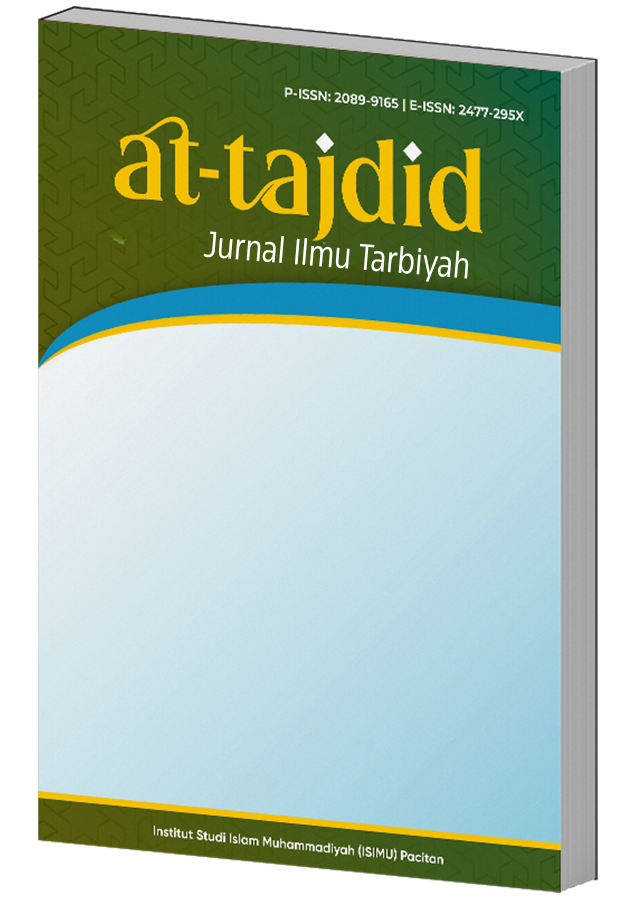
An Interdisciplinary Approach to Islamic Learning in Elementary Schools
DOI:
https://doi.org/10.52640/attajdid.336Keywords:
Learning, Interdisciplinary approach, Islamic religious educationAbstract
Monodisciplinary, text-oriented Islamic Religious Education (PAI) may limit students’ opportunities to connect Islamic teachings with contemporary realities. This study examines the relevance and implementation of an interdisciplinary approach to PAI in elementary education. It employs a descriptive qualitative design through library research, using qualitative content analysis to examine academic literature on interdisciplinary approaches, PAI, integrated learning, and elementary education. The findings identify three interconnected functions: integrating Islamic knowledge with other disciplines, contextualizing religious teachings within everyday life, and supporting holistic learning that connects knowledge, character, and practical skills. At the elementary level, implementation involves linking PAI competencies with other subjects through meaningful themes and real-life contexts. This model aligns with the integrated thematic framework of the 2013 Curriculum and the flexibility of the Merdeka Curriculum. The study concludes that interdisciplinary learning offers a conceptual and pedagogical framework for strengthening PAI’s contemporary relevance while preserving its religious foundations. Its effects on student engagement and learning outcomes require further empirical investigation.
Downloads
Published
Issue
Section
License
Copyright (c) 2024 Imro Atus Soliha, Tobroni, Faridi (Author)

This work is licensed under a Creative Commons Attribution 4.0 International License.

 Google Scholar
 Sinta: Science and Technology Index
 Garuda: Garba Rujukan Digital
 Mendeley
 Quillbot
 Turnitin
 Zotero